
Uncategorized

CHEOPS launch set for 17 Dec. 2019
The space telescope CHEOPS is scheduled to begin its journey into space on Tuesday, 17 December 2019 shortly before 10 a.m. CET. The Universities of Bern and Geneva are organizing events with a live stream from Kourou and space talks. “After over six years of intensive work, I am of course very pleased that the […]
Continue Reading
Studying exoplanetary atmospheres
Chloe Fisher is a PhD student at the Center of Space and Habitability (CSH) and associate of the NCCR PlanetS. In a video produced by the International Office of the University of Bern she talks about her work and life in Bern. Chloe Fisher is originally from the United Kingdom. Her project at CSH is […]
Continue Reading
Lively discussions and a prize for a short film
At the “Global Science Film Festival” in Bern and Zürich astrophysicists associated with PlanetS discussed a movie about an Indian Mars mission. The documentary “Bern on the Moon” was awarded the audience prize in the category short films. Susanne Wampfler, Professor at the Center for Space and Habitability (CSH) of the University of Bern, was […]
Continue Reading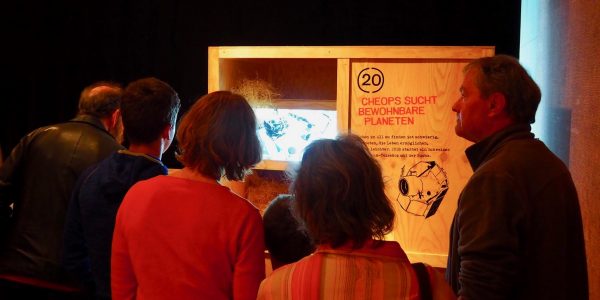
“Fragile – collected, hunted, explored”
Exhibition in Winterthur From 10 November 2019 to 15 March 2020, the Naturmuseum Winterthur is showing its award-winning special exhibition “Fragile – collected, hunted, researched”. The exhibition, produced by Naturama Aargau, deals with quirky collectors, tough explorers, eccentric hunters and tireless researchers. The exhibition space becomes a collection depot. Well protected, each freight box contains […]
Continue Reading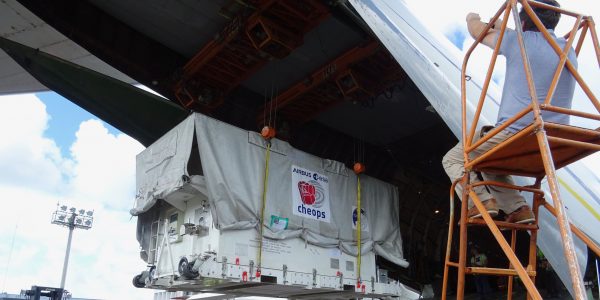
CHEOPS has arrived in Kourou
Last station before launch! The CHEOPS satellite has arrived by plane on 16 October 2019 at Europe’s Spaceport Kourou in French Guiana. Now CHEOPS is being prepared to launch into space soon with Soyuz VS23. Once in orbit around the Earth, it will begin to measure the exact radii of planets in distant solar systems […]
Continue Reading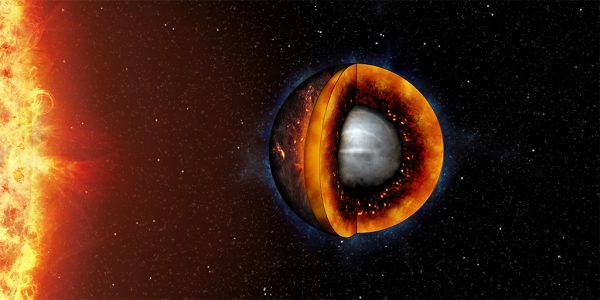
Liquifying a rocky exoplanet
A hot, molten Earth would be around 5% larger than its solid counterpart. This is the result of a study led by researchers at the University of Bern. The difference between molten and solid rocky planets is important for the search of Earth-like worlds beyond our Solar System and the understanding of Earth itself. Rocky […]
Continue Reading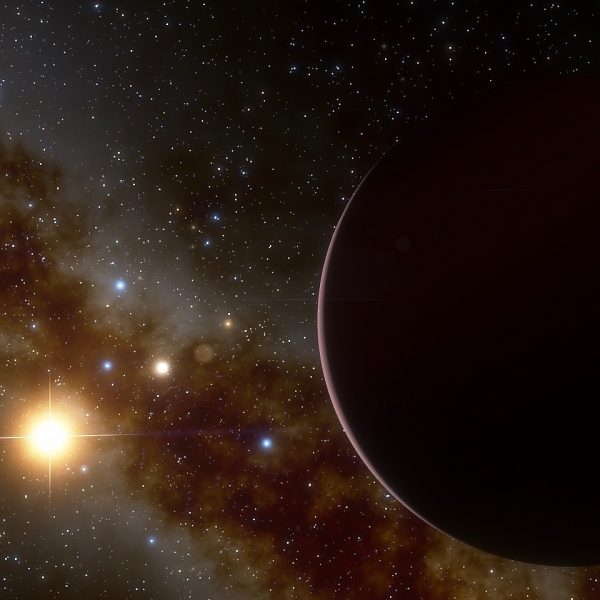
A planet that should not exist
Astronomers detected a giant planet orbiting a small star. The planet has much more mass than theoretical models predict. While this surprising discovery was made by a Spanish-German team, researchers at the University of Bern studied how the mysterious exoplanet might have formed. The red dwarf GJ 3512 is located 30 light-years from us. Although […]
Continue Reading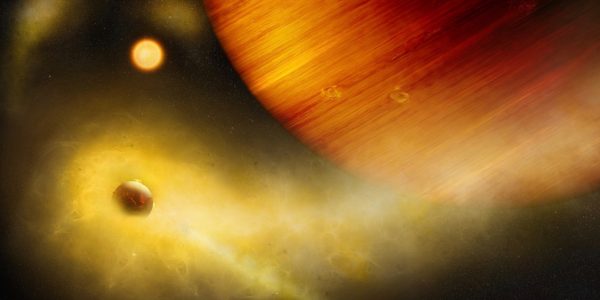
Hints of a volcanically active exomoon
A rocky extrasolar moon (exomoon) with bubbling lava may orbit a planet 550 light-years away from us. This is suggested by an international team of researchers led by the University of Bern on the basis of theoretical predictions matching observations. The “exo-Io” would appear to be an extreme version of Jupiter’s moon Io. Jupiter’s moon […]
Continue Reading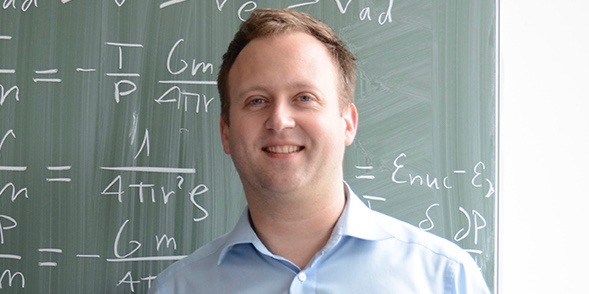
Observing planets as they form
By Christoph Mordasini Astrophysics – the branch of physics that aims at explaining astronomical observations – differs from most other branches of physics by the comparatively minor availability or sometimes even absence of laboratory experiments. While crucial laboratory experiments do exist for several physical systems and processes that are relevant in astrophysics and in particular […]
Continue Reading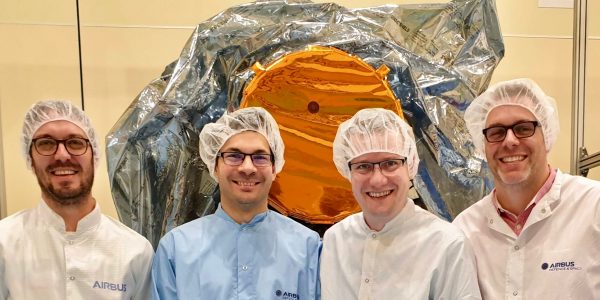
“Now CHEOPS is ready for transport to Kourou”
The space telescope CHEOPS is foreseen to launch in the last quarter of 2019. “In July, we carried out the final tests on the instrument at Airbus in Madrid,” says project manager Christopher Broeg: “Now CHEOPS is ready for transport to Kourou.” PlanetS: The work on the CHEOPS space telescope was actually completed months ago […]
Continue Reading