
STP12: Development of an Optical Telescope for Space communication, at Thales Alenia Space, Switzerland
Abstract
Thales Alenia Space in Switzerland (TAS-CH) designs several telescopes for space applications. Some are developed from heritage and some are built anew. This report presents the development and optimization of one such optical telescope for space communication at Thales Alenia Space in Switzerland. The project employed ray tracing softwares, CodeV and Zemax, to optimize the optical system and conduct tolerance analysis. Furthermore, Siemens NX was utilized to update the mechanical drawing obtained from the raytracing software, to comply with the shapes and dimensions feasible for manufacturing precision grade optics. The project was successfully handed over to TAS-CH as a requirements compliant optical system.
Introduction
Thales Alenia Space at Switzerland is a company that works on space technology, contributing significantly to optical systems for Earth observation, satellite communication, and scientific missions. The company has played a crucial role in advancing optical communication payloads, as well as per Earth Observation and Solar System Exploration. This project contributes to Thales Alenia Space’s optical communication developments by performing the optical design of a telescope, tailored for intersatellite communication over long distances. The main objective of the project/externship includes the following:
- Understand the heritage optical design used for space application and map the design to the current requirements by TAS-CH.
- Summarize the set of optical requirements against which the new telescope design shall be developed.
- Use an optical software (Zemax or CodeV) and develop the new optical design.
- Optimize the design to satisfy the requirements. Perform tradeoffs and report the non-compliant / partially compliant aspects of the design.
- Perform Tolerance and sensitivity analysis of the optical design.
Optical Design and Optimization
The communication satellite consists of an all mirror based reflective telescope. The telescope’s optical design is borrowed from a heritage optical system built at TAS-CH. The position of the cardinal points together with the mechanical constraints drives the configuration and properties of each mirror of the telescope. CodeV and Zemax are two industry-standard ray tracing software tools known for their precision and efficiency in optical system design and optimization. The heritage optical system was developed in CodeV. But, owing to my familiarity in using Zemax, the new optical design was adopted into Zemax. It was later migrated back to CodeV to maintain the compatibility with all the previous designs of the optical system.
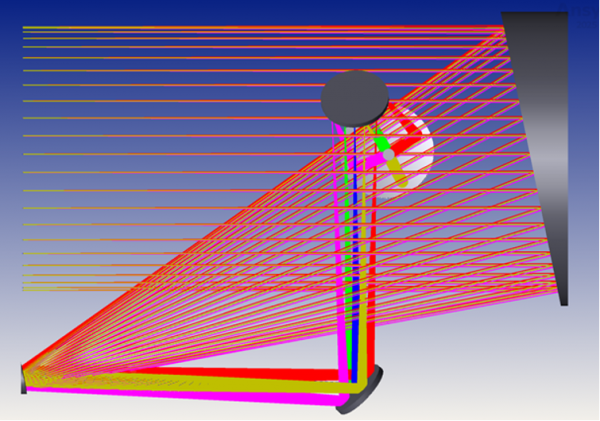
Optical layout of the telescope, designed using ZEMAX.
The first step of the telescope design process involved a replication of the CodeV heritage design into Zemax. The translation predominantly involved the conversion of CodeV mirror angles into Zemax compatible co-ordinate breaks. The performance parameters of the design, like the wavefront errors, were compared to the heritage design. Upon successful transition, a general merit function table including various operands was generated and used further in the optimization process. Here, degrees of freedom, i.e. the parameters of the telescope optics, such as all radii of curvature and distances between the mirrors, were chosen as Zemax variables. The RMS wavefront error was chosen as a main evaluation criterion during the optimization process. This process established the framework and the parameter space, around which the design could evolve to meet the requirements of the current project. Four steps were involved in the optimization process –
- Define a lower and upper limit of each Zemax variable. This constraints the parameter space around which the design can evolve. It is mostly the mechanical constraints, e.g. minimal mechanical clearances between the optical beam and the optical elements, and a global mechanical envelope, which needed to be considered.
- Perform a local damped least squared optimization.
- Analyze the design performance and compare it with the requirements. If the design is noncompliant, repeat from step 1 with modified boundaries.
- If the optical system does not converge to a desired solution, perform a trade-off study on the requirements and repeat step 1.
A compliant optical design was obtained through the optimization process and the design was migrated back to Code V for perfoming a tolerance analysis.
Tolerance and sensitivity analysis using CodeV
Optical systems that operate in space are subjected to high vibration loads during launch and thermal loads during operation. It is therefore important to determine the sensitivity of the optics to stress induced deformation. Further, the nominal optical design is different from the as-built optical system after manufacturing. Critical applications are sensitive to these changes. So, tolerance analysis was performed on the optical system to determine its predicted as-build performance. Sensitivity analysis was performed on the nominal system to determine the worst offenders from all degrees of freedom of the optical elements. This information was compiled into a sensitivity matrix, and distributed to the respective engineers for a study on mechanical feasibility. Another important question that was addressed was the introduction of alignment compensators, which relates to the telescope alignment feasibility. The tolerancing and sensitivity analysis were performed in CodeV due to its robust tolerancing algorithms. The optical design was then exported into a *.step CAD file. CodeV exports mirrors as an infinitesimally thin surface. So, to represent these surfaces with some physical thickness, Siemens NX was used to extrude the surfaces.
Conclusion and Acknowledgement
The work yielded a well optimized, requirements compliant optical system, that helps TAS-CH to implement an upgraded optical communication system. This work was carried out using Zemax and CodeV. This process of design and optimization gave me a great insight into optical design in industries. I also learned to use CodeV, an industrial standard for sequential ray tracing. I would like to thank PlanetS for funding this externship through the TIP program. I would like to thank TAS-CH, the line manager Antonio Casciello and optical engineer Jaaroslav Hopp for their time and stimulating discussions.