CHEOPS
The CHaracterizing ExoPlanets Satellite (CHEOPS) is a joint mission between ESA and Switzerland launched in 2019. ESA’s Science Programme has selected CHEOPS in 2012 as the first small mission (S-mission) in its Programme (see CHEOPS Website).
CHEOPS is the first mission dedicated to search for transits by means of ultrahigh precision photometry on bright stars already known to host planets. By being able to point at nearly any location on the sky, it provides the unique capability of determining accurate radii for a subset of those planets for which the mass has already been estimated from ground-based spectroscopic surveys. It is also providing precision radii for new planets discovered by the next generation ground-based transits surveys (Neptune-size and smaller).
The purpose of the CHEOPS Platform within our NCCR is to provide the organisation and the funding for a high-visibility science exploitation of the mission. In particular it will create a pool of young scientists not attributed to a specific institute but encouraged to work across institutional boundaries. The CHEOPS pool is composed of:
- PhD students who are incorporated in the PlanetS doctoral network organised by the NCCR
- CHEOPS Fellows who are competitively selected postdocs, who are offered fellowships with a small research budget (10 kCHF/year) for travel and miscellaneous expenses. The CHEOPS Fellows are encouraged to take advantage of the interdisciplinary work carried out within the NCCR
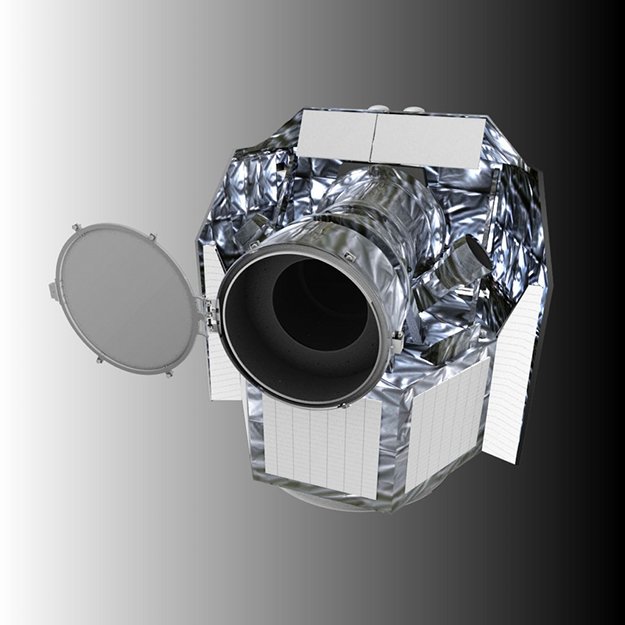
Artist representation of the CHEOPS satellite
(credit:ESA)